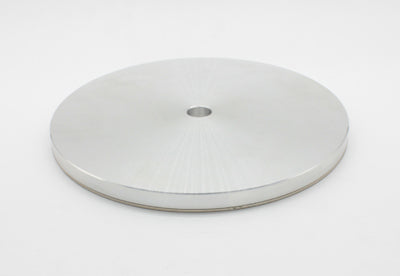
Collection: Ripple Faceting Laps
Professional diamond ripple faceting laps with a wave-pattern surface texture that reduces friction, improves coolant distribution, and delivers a smoother cutting action than flat or channel laps. Minimizes stone chatter and provides more controlled material removal — ideal for fine faceting stages and delicate gemstone work where precise facet geometry is critical. Available in 6" ($65.00) and 8" ($75.00) diameters across grit 60 to 3000. Compatible with all standard faceting machines via 1/2" arbor hole.
Available Sizes & Pricing
| Diameter |
Arbor |
Grit Range |
Price |
| 6" (150mm) |
1/2" |
60, 80, 120, 180, 220, 280, 360, 600, 1200, 3000 |
$65.00 |
| 8" (200mm) |
1/2" |
60, 80, 120, 180, 220, 280, 360, 600, 1200, 3000 |
$75.00 |
Grit Selection Guide
| Grit |
Stage |
Application |
| 60–80 |
Coarse shaping |
Initial facet cutting, rapid material removal on rough gem material |
| 120–180 |
Medium shaping |
Facet refinement, removing coarse grinding scratches |
| 220–360 |
Fine shaping |
Precise facet geometry, controlled surface smoothing |
| 600–1200 |
Pre-polish |
Scratch removal, surface preparation for polishing laps |
| 3000 |
Fine pre-polish |
Near-polish surface quality before final metal lap polish stage |
Ripple Pattern Advantages
- Wave-pattern surface reduces friction between lap and gemstone during cutting
- Improved coolant distribution across the lap surface during wet faceting
- Minimizes stone chatter for more controlled, precise material removal
- Smoother cutting action reduces risk of chipping on delicate gem edges
- Particularly effective for fine faceting stages (220–3000 grit) and delicate gem work
Related Tools
Frequently Asked Questions
-
Q: What is the advantage of ripple faceting laps over standard flat laps?
A: The wave-pattern surface of ripple laps reduces friction and stone chatter during faceting, delivering a smoother, more controlled cutting action than flat laps. This is particularly beneficial for fine faceting stages (220–3000 grit) where precise facet geometry and minimal surface damage are critical. Standard flat laps provide more total diamond contact area for faster material removal in coarser shaping stages.
-
Q: Are ripple laps better for beginners or experienced faceters?
A: Ripple laps are beneficial for all skill levels, but particularly valuable for intermediate and advanced faceters working on fine faceting stages where stone chatter and surface quality are critical concerns. Beginners may find standard flat laps easier to start with for coarse shaping, then switch to ripple laps for fine faceting and pre-polish stages.
-
Q: What gemstones benefit most from ripple faceting laps?
A: Ripple laps are particularly effective for delicate gemstones prone to chipping or chatter during faceting, such as topaz (Mohs 8, perfect cleavage), tourmaline (Mohs 7–7.5), and beryl/aquamarine (Mohs 7.5–8). The reduced friction and smoother cutting action minimizes the risk of cleavage fractures and edge chipping on these sensitive gem materials.
-
Q: Can ripple faceting laps be used for coarse shaping as well as fine faceting?
A: Yes — ripple laps are available in the full grit range from 60 to 3000, covering coarse shaping through fine pre-polish stages. However, the ripple pattern's advantages are most pronounced in fine faceting stages (220–3000 grit) where controlled material removal and surface quality are most important. For coarse shaping (60–80 grit), standard flat laps may be more cost-effective.
-
Q: How do ripple laps compare to channel laps for wet faceting?
A: Both ripple and channel laps improve upon standard flat laps for wet faceting, but in different ways. Channel laps focus on improving water and swarf flow through precision-cut grooves — best for heat management and lap longevity. Ripple laps focus on reducing friction and stone chatter through the wave-pattern surface — best for smooth, controlled cutting action and delicate gem work. Many faceters use channel laps for coarser stages and ripple laps for fine faceting.