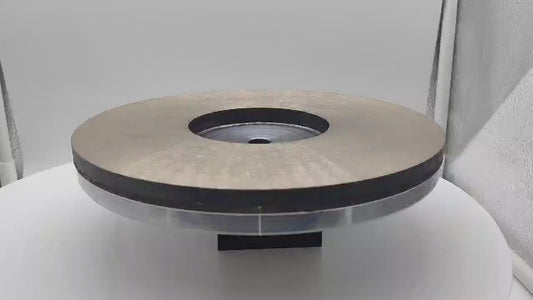
Collection: Sintered Diamond Laps
Sintered Diamond Faceting Laps – Long-Life Professional Laps for High-Volume Gemstone FacetingProfessional sintered diamond faceting laps with diamond particles embedded throughout the entire metal matrix — not just surface-coated. As the surface wears, fresh diamond is continuously exposed, delivering consistent cutting performance and significantly longer service life than electroplated laps. The preferred choice for professional faceters and high-volume lapidary operations. Available in 6" ($250.00) and 8" ($415.00) diameters across grit 60 to 600. Compatible with all standard faceting machines via 1/2" arbor hole.
🔥 Shop Sintered Diamond Laps – From $250.00
Available Sizes & Pricing
| Diameter |
Arbor |
Grit Range |
Price |
Construction |
| 6" (150mm) |
1/2" |
60, 180, 220, 280, 600 |
$250.00 |
Sintered diamond throughout metal matrix |
| 8" (200mm) |
1/2" |
80, 100, 180, 600 |
$415.00 |
Sintered diamond throughout metal matrix |
Sintered vs Electroplated Faceting Laps
| Feature |
Sintered Diamond Laps |
Electroplated Diamond Laps |
| Diamond distribution |
Throughout entire metal matrix |
Surface coating only |
| Service life |
5–10× longer |
Standard |
| Cutting consistency |
Consistent throughout life |
Decreases as surface wears |
| Initial cost |
Higher ($250–$415) |
Lower ($20–$75) |
| Long-term value |
Superior for high-volume use |
Better for occasional use |
| Best for |
Professional, high-volume faceting |
Hobbyist, occasional faceting |
Compatible Gemstones
- All standard faceting gem materials (Mohs 5–9)
- Sapphire and ruby (Mohs 9) — sintered construction handles hard gems efficiently
- Topaz (Mohs 8), tourmaline (Mohs 7–7.5), beryl/aquamarine (Mohs 7.5–8)
- Quartz family (Mohs 7), garnet (Mohs 6.5–7.5)
Related Tools
Frequently Asked Questions
-
Q: Why are sintered diamond faceting laps so much more expensive than standard electroplated laps?
A: Sintered laps have diamond particles embedded throughout the entire metal matrix — a significantly more complex and material-intensive manufacturing process than electroplating a thin diamond layer on the surface. The higher initial cost is offset by 5–10× longer service life: a sintered lap at $250–$415 that lasts 500–1000+ hours delivers better long-term value than multiple electroplated laps at $20–75 each that last 50–200 hours.
-
Q: What grit sintered lap should I use for faceting sapphire?
A: For sapphire (Mohs 9), start with 80–100 grit sintered lap for initial facet cutting and rapid material removal. Progress to 180 grit for facet refinement, then 600 grit for pre-polish preparation. Finish with a tin polishing lap charged with 14,000–80,000 grit diamond compound for the final mirror polish. Sintered laps are particularly well-suited for hard gems like sapphire where electroplated laps wear quickly.
-
Q: How do I know when a sintered diamond lap needs replacing?
A: Sintered laps are ready for replacement when cutting action noticeably slows even after cleaning, when the lap surface appears glazed or smooth under magnification, or when facet quality deteriorates despite correct technique. Unlike electroplated laps that fail suddenly when the surface coating wears through, sintered laps degrade gradually — giving you advance warning before performance becomes unacceptable.
-
Q: Can sintered diamond laps be used dry?
A: Wet use with water cooling is strongly recommended for all sintered diamond lap applications. Water reduces heat buildup, extends lap life, flushes gem particles from the lap surface, and improves cutting consistency. Dry use is possible for short periods but significantly reduces lap life and risks thermal damage to heat-sensitive gemstones.
-
Q: Are sintered laps worth the investment for a hobbyist facetor?
A: For occasional hobbyist faceting (a few stones per month), electroplated standard laps offer better value due to their lower initial cost. Sintered laps become the better investment for faceters cutting 10+ stones per month or working with hard gem materials (Mohs 8+) where electroplated laps wear quickly. If you facet regularly and want to minimize lap replacement frequency, sintered laps are worth the investment.