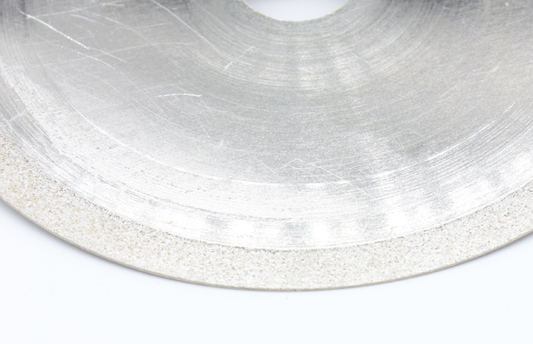
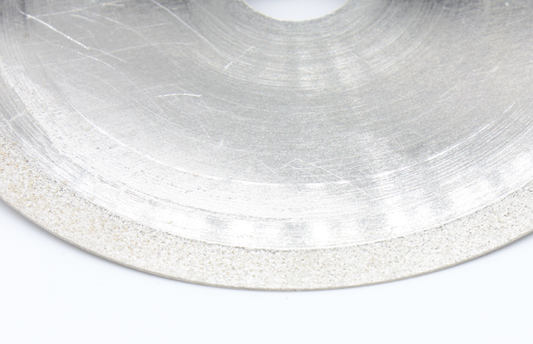
Kolekcja: Red Thin Rim Diamond Saws
Professional red thin rim sintered diamond saw blades for precision lapidary slabbing, trim sawing, and fine stone cutting. Sintered diamond construction with a thin rim profile delivers minimal material loss (kerf 0.012"–0.048") and clean, accurate cuts on gemstones, minerals, glass, and ceramic. Available in 4" to 14" diameters with 1/2" and 5/8" arbor options. From $20.00.
Available Sizes & Pricing
| Diameter |
Kerf |
Arbor |
Price |
| 4" |
0.012"–0.016" |
1/2", 5/8" |
$20.00–$45.00 |
| 5" |
0.012"–0.016" |
1/2", 5/8" |
$22.00 |
| 6" |
0.012"–0.024" |
1/2", 5/8" |
$30.00 |
| 8" |
0.024"–0.032" |
1/2", 5/8" |
$35.00 |
| 10" |
0.030"–0.036" |
1/2", 5/8" |
$45.00–$50.00 |
| 12" |
0.036"–0.048" |
1/2", 5/8" |
$50.00 |
| 14" |
0.036"–0.048" |
1/2", 5/8" |
$60.00 |
Kerf Selection Guide
| Kerf |
Material Loss |
Best For |
Notes |
| 0.012"–0.016" |
Ultra-thin |
Precious gemstones, expensive rough, thin slabs |
Minimum material waste, requires stable saw setup |
| 0.020"–0.024" |
Thin |
Semi-precious stones, general lapidary slabbing |
Good balance of material conservation and blade stability |
| 0.028"–0.032" |
Standard thin |
Agate, jasper, quartz, general lapidary |
Versatile for most lapidary trim saw applications |
| 0.036"–0.048" |
Medium |
Larger diameter blades, harder materials |
Required for larger blade stability at higher diameters |
Compatible Applications
- Lapidary trim sawing and slabbing of gemstones and minerals
- Precision cutting of agate, jasper, quartz, opal, and semi-precious stones
- Glass, ceramic, and porcelain tile cutting
- Fossil and petrified wood slabbing
- Compatible with standard lapidary trim saws and slab saws
Related Tools
Frequently Asked Questions
-
Q: What is the advantage of thin rim sintered diamond saw blades over standard blades?
A: Thin rim sintered blades minimize material loss (kerf) during cutting — critical when working with expensive or rare gemstone rough where every millimeter of material matters. Sintered construction (diamond throughout the blade body) also provides longer service life than electroplated blades, maintaining consistent cutting performance as the blade wears. The thin rim profile reduces cutting resistance and heat generation for cleaner, more precise cuts.
-
Q: What kerf thickness should I choose for lapidary trim sawing?
A: For precious gemstones and expensive rough where material conservation is critical, choose 0.012"–0.016" kerf. For general lapidary trim sawing of semi-precious stones, 0.020"–0.024" kerf provides a good balance of material conservation and blade stability. For larger diameter blades (10"+) and harder materials, 0.036"–0.048" kerf is required for adequate blade rigidity and stability during cutting.
-
Q: What arbor size do I need — 1/2" or 5/8"?
A: Check your lapidary saw's spindle diameter. Most standard lapidary trim saws use 1/2" arbors; some larger slab saws use 5/8" arbors. If your saw uses a different arbor size, check our Saw Blade Arbor Adapters collection for compatible adapters. Always verify your machine's arbor size before ordering.
-
Q: Do red thin rim sintered blades require water cooling?
A: Yes — water cooling is essential for all diamond saw blade applications. Water reduces heat buildup, extends blade life, flushes stone particles from the blade, and prevents thermal cracking of the workpiece. Always use adequate water flow during cutting. Running a diamond saw blade dry will rapidly destroy the blade and can cause dangerous blade failure.
-
Q: What is the difference between red thin rim and standard lapidary saw blades?
A: Red thin rim blades have a thinner kerf (0.012"–0.048") than standard lapidary blades, minimizing material loss during cutting. The sintered construction provides longer service life. Standard lapidary blades typically have thicker kerfs (0.060"+) that are more forgiving in less precise setups but waste more material per cut. Choose thin rim blades when material conservation and cut precision are priorities.