Collection: Abrasive Polishing Laps
Complete range of precision abrasive lapping film in four abrasive types — diamond, silicon carbide (SiC), aluminium oxide (AlOx), and silicon dioxide (SiO₂) — available in disc, roll, and sheet formats. Resin-bonded abrasive on polyester or Mylar film backing delivers consistent, controlled material removal from coarse lapping through sub-micron mirror finishing. Micron range: 0.2μm to 80μm. Applications include semiconductor wafers, optical components, fiber optics, microelectronics, metallography, ceramics, and lapidary.
Product Format Guide
| Format |
Sizes |
Abrasive Types |
Price From |
Best For |
| Discs (10-pack) |
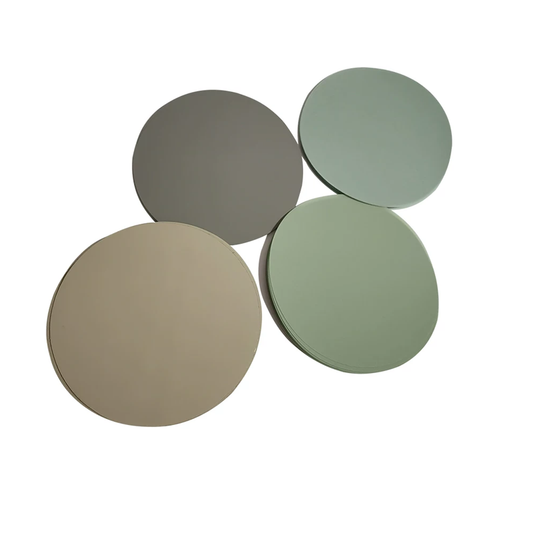
6", 8" |
SiC, AlOx |
$16.00 |
Flat lap machines, backing plates, PSA or plain mount |
| Sheets (5-pack) |
280×220mm |
Diamond, SiC, AlOx |
$16.00 |
Hand lapping, glass plates, custom cutting to size |
| Rolls (narrow) |
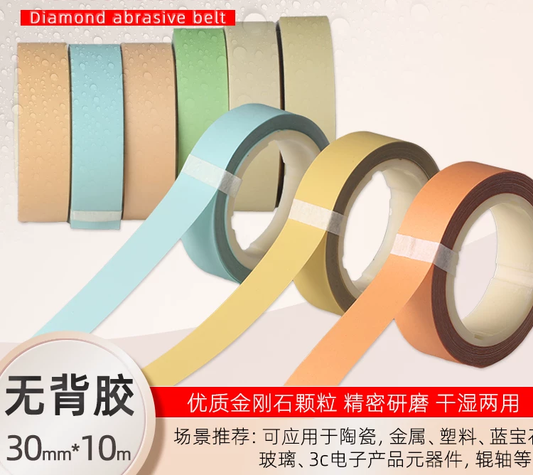
30mm×10M, 55mm×20M |
Diamond |
$100.00 |
Fiber optic polishing, narrow-format precision lapping |
| Rolls (wide, 101mm) |
5M, 10M, 45M |
Diamond, SiC, AlOx, SiO₂ |
$38.00 |
Production lapping, custom disc cutting, roll-to-roll systems |
Abrasive Type Selection Guide
| Abrasive |
Hardness |
Micron Range |
Best For |
| Diamond |
Mohs 10 |
0.5–80μm |
Hard gems (Mohs 7+), carbide, sapphire, hard ceramics — fastest cutting, longest life |
| Silicon Carbide (SiC) |
Mohs 9–10 |
1–60μm |
Non-ferrous metals, polymers, brittle substrates, glass — sharp, friable cutting action |
| Aluminium Oxide (AlOx) |
Mohs 8–9 |
0.3–60μm |
Optical components, semiconductors, fiber optics, medium-hard gems — controlled removal |
| Silicon Dioxide (SiO₂) |
Mohs 7 |
0.2μm only |
Final sub-micron mirror polish on optical glass, silicon wafers, precision surfaces |
Compatible Applications
- Semiconductor wafers, MEMS, ceramic capacitors, hard drive read-write heads
- Optical components: lenses, prisms, fiber optic connectors, laser components
- Metallography and petrographic sample preparation
- Advanced composites and brittle substrate lapping
- Lapidary gemstone pre-polish and final polish sequences
Related Tools
Frequently Asked Questions
-
Q: What is the difference between diamond, SiC, AlOx, and SiO₂ lapping film?
A: Diamond film (Mohs 10) is the hardest and fastest-cutting — ideal for hard gems (Mohs 7+), carbide, and sapphire. SiC film (Mohs 9–10) has a sharp, friable cutting action suited for non-ferrous metals, polymers, and brittle substrates. AlOx film (Mohs 8–9) delivers controlled material removal for optical components and semiconductor applications. SiO₂ film (0.2μm only) is used exclusively for final sub-micron mirror polishing of optical glass and silicon wafers.
-
Q: When should I use lapping film rolls versus discs or sheets?
A: Discs (6"/8", 10-pack) are ideal for flat lap machines with PSA or plain backing plate mounting. Sheets (280×220mm, 5-pack) suit hand lapping on glass plates and can be cut to custom sizes. Narrow rolls (30mm/55mm) are designed for fiber optic connector polishing. Wide rolls (101mm, 5M–45M) are for production lapping environments, roll-to-roll systems, and custom disc cutting.
-
Q: What micron grade should I start with for a complete lapping sequence?
A: Start at 15–30μm for coarse stock removal and scratch elimination, progress through 5–9μm for intermediate refinement, then 1–3μm for fine lapping, and finish with 0.3–0.5μm for near-mirror quality. For optical-grade mirror finish, complete with 0.2μm SiO₂ or 0.3μm CeO₂ film as the final stage.
-
Q: Can lapping film be used on a standard flat lap machine?
A: Yes — PSA-backed discs mount directly on flat lap platens or backing plates. Plain discs can be mounted with water tension on glass plates or with spray adhesive. For magnetic quick-change systems, use PSA-backed discs on a compatible backing plate adapter.
-
Q: What is silicon dioxide (SiO₂) lapping film used for?
A: Silicon dioxide lapping film (0.2μm) is used exclusively for the final sub-micron polishing stage on optical glass, silicon wafers, and precision optical surfaces where the absolute finest surface quality is required. It is softer than AlOx or diamond film and produces a chemomechanical polishing action that delivers optical-quality mirror finishes without introducing new surface defects.