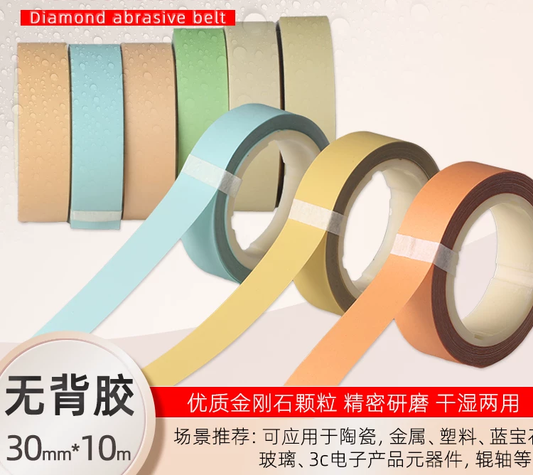
Kolekcja: Silicon Dioxide Lapping Film
Professional silicon dioxide (SiO₂) precision lapping film for final sub-micron polishing of optical glass, silicon wafers, fiber optic connectors, and precision optical surfaces. Available exclusively in 0.2μm grade — the finest abrasive grade in our lapping film range — in roll formats from 30mm to 101mm width and 5M to 45M length, with both PSA (peel-and-stick) and plain backing options. SiO₂ delivers a gentle chemomechanical polishing action that produces optical-quality mirror finishes without introducing micro-scratches or subsurface crystal damage.
Available Sizes & Pricing
| Format |
Width |
Length |
Micron Grade |
Backing Options |
Price |
| Roll |
30mm |
10M |
0.2μm |
PSA / Plain |
$80.00 |
| Roll |
101mm |
5M |
0.2μm |
PSA / Plain |
$150.00 |
| Roll |
101mm |
10M |
0.2μm |
PSA / Plain |
$250.00 |
| Roll |
101mm |
45M |
0.2μm |
PSA / Plain |
$1,200.00 |
SiO₂ vs Other Lapping Film Abrasives
| Abrasive Material |
Hardness |
Finest Grade |
Polishing Action |
Primary Application |
| Silicon Dioxide (SiO₂) |
Mohs 7 |
0.2μm |
Chemomechanical |
Final sub-micron mirror polish on optical glass & silicon wafers |
| Cerium Oxide (CeO₂) |
Mohs 6 |
0.3μm |
Chemomechanical |
Final mirror polish on glass, optics & softer gems |
| Aluminium Oxide (AlOx) |
Mohs 8–9 |
0.3μm |
Mechanical |
Optical components, semiconductors, medium-hard gems |
| Diamond |
Mohs 10 |
0.3μm |
Mechanical |
Hard gems (Mohs 7+), carbide, sapphire, hard ceramics |
Compatible Applications
- Silicon wafers, semiconductors, and MEMS substrate surfaces
- Optical glass: lenses, prisms, flats, optical windows, and laser mirrors
- Fiber optic connector end-face polishing and telecommunications components
- Precision optical assemblies requiring sub-micron scratch-free surfaces
- Microelectronics chemical-mechanical planarization (CMP) touch-up
Related Polishing Media & Support Laps
Frequently Asked Questions
-
Q: What is silicon dioxide lapping film used for, and why is it only available in 0.2μm?
A: Silicon dioxide (SiO₂) lapping film is used exclusively for the final sub-micron polishing stage on optical glass, silicon wafers, and precision optical surfaces. It is only available in 0.2μm because its chemomechanical polishing action — where SiO₂ reacts chemically with the glass surface while abrading mechanically — is most effective at this ultra-fine grade. Coarser SiO₂ grades would be less effective than diamond or AlOx film for intermediate lapping stages.
-
Q: What is the difference between SiO₂ and cerium oxide for final glass polishing?
A: Both SiO₂ and cerium oxide (CeO₂) use chemomechanical polishing action on glass surfaces. SiO₂ at 0.2μm delivers the finest possible surface finish and is preferred for semiconductor-grade silicon wafers and precision optical components where absolute surface quality is critical. Cerium oxide (0.3μm) is more commonly used for general glass polishing, lapidary, and optical lens work where the slightly coarser finish is acceptable.
-
Q: What lapping sequence should I use before switching to SiO₂ film?
A: Complete a full lapping sequence before using SiO₂ film: start with 15–30μm diamond or AlOx film for coarse lapping, progress through 5–9μm and 1–3μm for intermediate refinement, then 0.5μm AlOx or diamond for near-mirror quality, and finally 0.2μm SiO₂ for the optical-quality mirror finish. Skipping stages will leave residual scratches that SiO₂ film cannot remove efficiently.
-
Q: Can SiO₂ lapping film be used on gemstones?
A: SiO₂ lapping film (Mohs 7) is only effective on materials at or below its hardness level. It is not suitable for hard gemstones (Mohs 7+) such as agate, quartz, or sapphire — use diamond lapping film for these materials. SiO₂ film is specifically designed for optical glass and silicon wafer applications where its chemomechanical action provides unique advantages over harder abrasives.
-
Q: What is the difference between 30mm and 101mm width SiO₂ lapping film rolls?
A: The 30mm×10M narrow roll is designed for fiber optic connector polishing and precision small-format lapping applications. The 101mm wide rolls (5M, 10M, 45M) are for larger-format optical polishing, production lapping environments, and custom disc cutting. Choose the 45M roll for high-volume production use where per-meter cost efficiency is important.