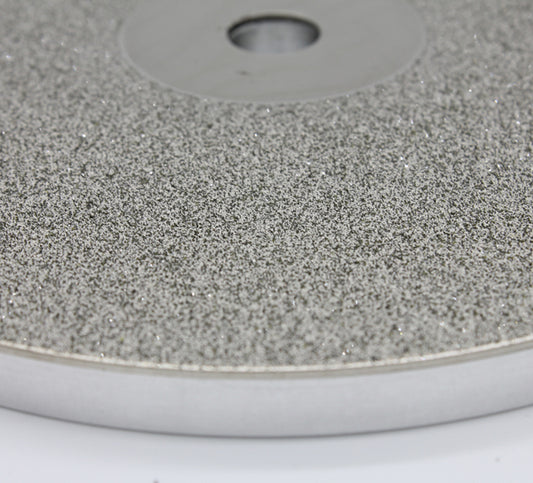
Kolekcja: Standard Faceting Laps
Professional diamond standard faceting laps for consistent, reliable gemstone faceting across all skill levels. Flat diamond surface with 1/2" arbor hole — compatible with all standard faceting machines. Available in 6" ($27.00) and 8" ($40.00) diameters across a complete grit range from 60 to 3000, covering coarse shaping through fine pre-polish stages. The standard flat surface provides maximum diamond contact area for efficient material removal and accurate facet geometry.
Available Sizes & Pricing
| Diameter |
Arbor |
Grit Range |
Price |
| 6" (150mm) |
1/2" |
60, 80, 120, 180, 220, 280, 360, 600, 1000, 1200, 1500, 3000 |
$27.00 |
| 8" (200mm) |
1/2" |
60, 80, 120, 180, 220, 280, 360, 600, 1200, 1500, 3000 |
$40.00 |
Grit Selection Guide
| Grit |
Stage |
Application |
| 60–80 |
Coarse shaping |
Initial facet cutting, rapid material removal, rough gem shaping |
| 120–180 |
Medium shaping |
Facet refinement, removing coarse grinding scratches |
| 220–360 |
Fine shaping |
Precise facet geometry, surface smoothing before pre-polish |
| 600–1200 |
Pre-polish |
Scratch removal, surface preparation for polishing laps |
| 1500–3000 |
Fine pre-polish |
Near-polish surface quality, minimal scratch depth before final polish |
Compatible Gemstones
- Quartz family: amethyst, citrine, smoky quartz, rose quartz (Mohs 7)
- Topaz (Mohs 8), tourmaline (Mohs 7–7.5), beryl/aquamarine (Mohs 7.5–8)
- Sapphire and ruby (Mohs 9) — use coarser grits for initial shaping
- Garnet (Mohs 6.5–7.5), peridot (Mohs 6.5–7), zircon (Mohs 7.5)
- All standard faceting gem materials
Related Tools
Frequently Asked Questions
-
Q: What grit standard faceting lap should I start with for a new gemstone?
A: Start with 60–80 grit for initial facet cutting and rapid material removal on a new rough gem. Progress to 120–180 grit for facet refinement, then 220–360 grit for precise geometry and surface smoothing. Finish with 600–1200 grit for pre-polish preparation before switching to a tin or zinc polishing lap with diamond compound for the final mirror polish.
-
Q: What is the difference between standard, channel, and ripple faceting laps?
A: Standard laps have a flat, uninterrupted diamond surface providing maximum contact area for efficient material removal — the most versatile choice for all faceting stages. Channel laps have precision-cut grooves that improve water and swarf flow during wet faceting, reducing heat and extending lap life. Ripple laps have a wave-pattern surface that reduces friction and stone chatter, delivering a smoother cutting action ideal for fine faceting and delicate gem work.
-
Q: Are standard faceting laps compatible with all faceting machines?
A: Yes — standard faceting laps with 1/2" arbor holes are compatible with virtually all standard faceting machines, including Graves, Ultra Tec, Facetron, Raytech, and most other major brands. Always verify your machine's lap diameter (6" or 8") and arbor size before ordering.
-
Q: How do I progress from diamond faceting laps to polishing laps?
A: After completing the faceting sequence through 1200–3000 grit on a standard diamond lap, switch to a metal polishing lap (tin or zinc) charged with diamond compound (14,000–80,000 grit) for the final mirror polish. The transition from diamond laps to polishing laps is the critical step that produces the gem's final brilliance and surface quality.
-
Q: How long do diamond standard faceting laps last?
A: Diamond faceting lap life depends on gem hardness, applied pressure, and whether wet or dry use. On standard gem materials (Mohs 7–8), a quality diamond faceting lap typically lasts 50–200+ hours of use. Always use water cooling and light, consistent pressure to maximize lap life. Coarser grits (60–80) wear faster due to higher material removal rates.